Last week, I fell into a familiar spiral. My phone buzzed with notifications about new tariffs that could impact our business—a situation I've been trying to prepare for, but that remains outside my control. As I was frantically researching potential impacts, my toddler decided it was the perfect moment to need my undivided attention.
There I was, one hand doom-scrolling tariff predictions and the other trying to build a block tower with a toddler who found my stress irrelevant. Life's grand plans, meet reality's wrecking ball.
That evening, I did something that sounds strange but always helps reset my perspective. I watched a space documentary. I like to watch films about space when I’m stressed because seeing that pale blue dot in the vastness of space puts my problems in perspective. We're just living on a rock flying through space, and most of our daily anxiety won't matter in the grand scheme of things.
It reminded me of something I read recently from Robert Greene, who warns how we unknowingly "poison our own minds" by constantly reacting to external drama. He writes: "You are continually reacting to what people give you, experiencing waves of excitement, insecurity, and anxiety that make it hard to focus."
The very act of consuming anxiety-inducing information without a clear purpose leaves us not more informed, but more infected.
What struck me is this: we imagine we’re gathering useful data, but we’re really feeding emotional contagion. We become trapped in loops of reactivity rather than calm, deliberate action.
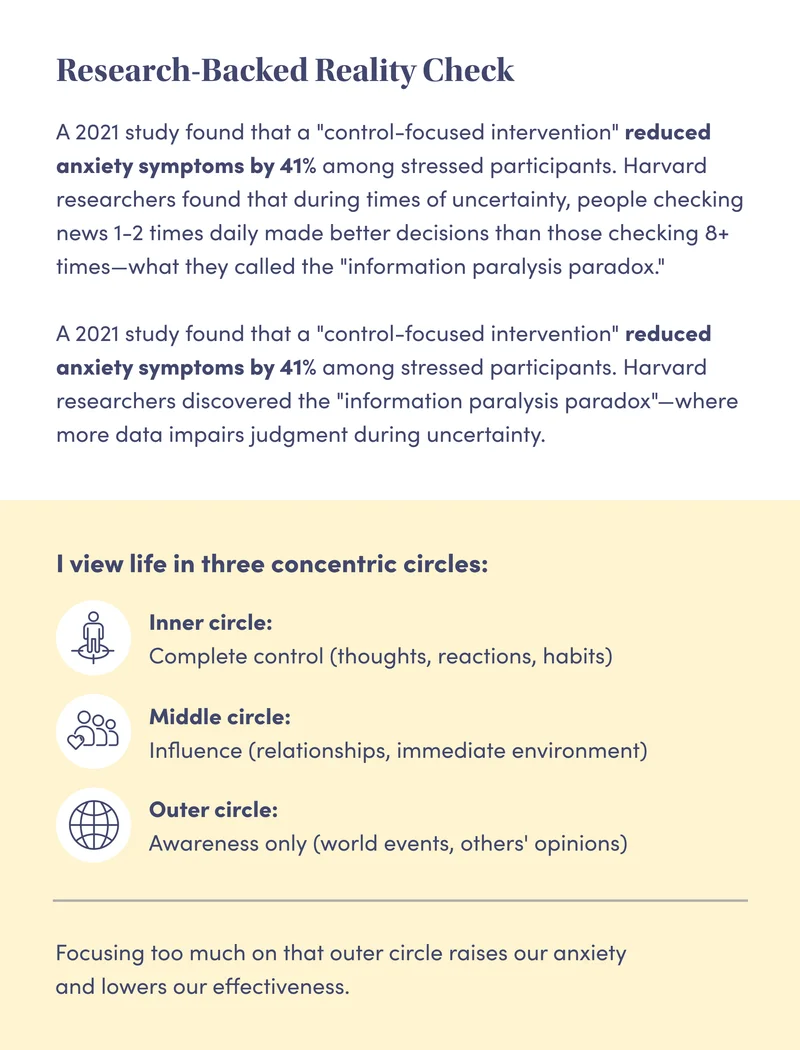
Key insight: In times of uncertainty, focusing on what you can control isn't just comforting—it's strategically smart. Research shows it's the difference between productive action and anxious paralysis. Directing our energy toward what we can influence reduces stress and increases effectiveness.
This matters more than ever today. Between social media algorithms designed to hijack our attention and news media following the "if it bleeds, it leads" principle, we're constantly battling forces engineered to pull us toward what's dramatic rather than what's important.
The Unprotected Mind
Despite my best intentions to be present with my family, my thumb opens social media during quiet moments with my toddler. Our ancient brains weren't designed for today's stimulation. The irony isn't lost on me: I create productivity tools, yet struggle with the same digital pull as everyone else.
In our recent customer survey, 78% of you reported feeling "frequently overwhelmed" by information overload, with most citing "negative effects on either sleep, productivity, or relationships." It's a modern epidemic and something I’m working on a solution around…









![Email from BestSelf Co.. [Winning Wednesday] The 15-minute hack that tripled my productivity (+ free tool)](https://n5su3bze2ea.b-cdn.net/preview-images/89c923de-a93c-491b-987d-90339bd51133/BestSelf-Co.-emails-winning-wednesday-the-15-minute-hack-that-tripled-my.webp?bunny=%5Bobject%20Object%5D&width=300&height=600&aspect_ratio=300%3A600)

