

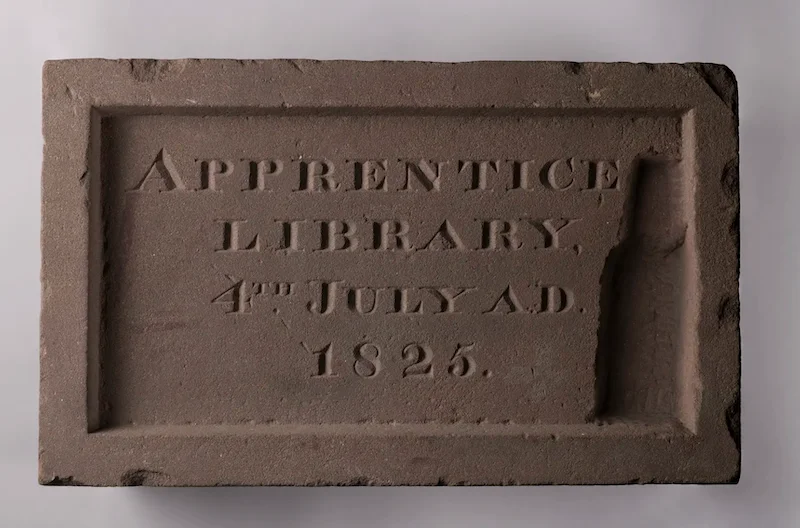
July 4 is a time to celebrate the birth . . . of the Brooklyn Museum!
The story begins in a tavern on August 7, 1823. A group of Brooklyn citizens met to discuss forming a library for tradesmen and local youths. This was a forward-thinking idea: The concept of public libraries was still in its infancy.
During a Fourth of July event two years later, Revolutionary War hero General Marquis de Lafayette helped lay the cornerstone (pictured above) for the first building of the Brooklyn Apprentices’ Library. It was placed at the corner of Henry and Cranberry Streets, in what is now Brooklyn Heights.
The American poet Walt Whitman would recount the day in the Brooklyn Standard newspaper in 1862. Lafayette had supposedly picked up Whitman, a child at the time, to give him a better view of the event.
The Brooklyn Apprentices’ Library, the first public circulating library in Brooklyn, would evolve into the Brooklyn Museum we know and love today.
See this piece of history and many more in Breaking the Mold: Brooklyn Museum at 200, which celebrates the institution’s unique legacy.
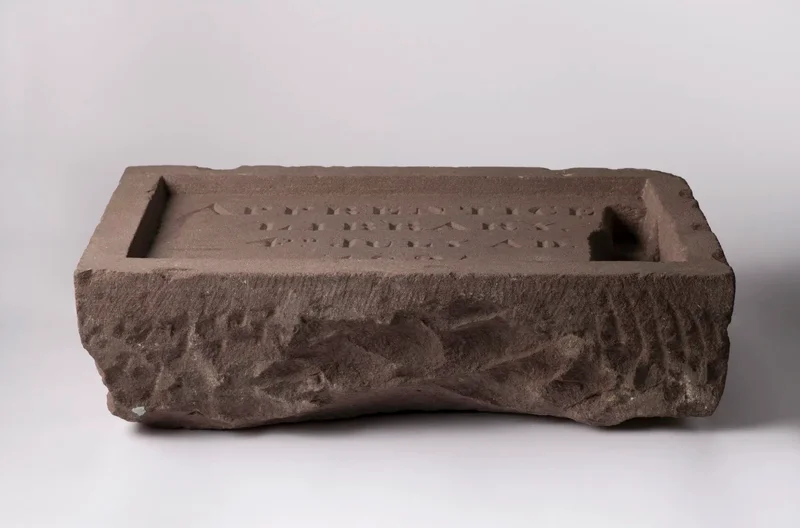
What’s that large indent on the cornerstone’s right-hand side?
This bottle-shaped space was a mystery to us until very recently. Hop over to our Instagram to hear Abigail Dansiger, Director of Libraries and Archives, explain what was inside.
Keepsakes
Take home your own piece of Brooklyn Museum history.
From the top: Unknown artist. Cornerstone with Hollow Place for Bottle of Liquor, Laid by General Lafayette, ca. 1825. Limestone. Brooklyn Museum, Brooklyn Museum Collection, X706.1. (Photo: Brooklyn Museum); Image courtesy of the Brooklyn Museum Shop
Breaking the Mold: Brooklyn Museum at 200 is organized by Meghan Bill, Coordinator of Provenance; Abigail Dansiger, Director of Libraries and Archives; Catherine Futter, Director of Curatorial Affairs and Senior Curator of Decorative Arts; Liz St. George, Assistant Curator, Decorative Arts; and Pauline Vermare, Phillip and Edith Leonian Curator of Photography; with Kimberli Gant, Curator, Modern and Contemporary Art; Carmen Hermo, former Associate Curator, Elizabeth A. Sackler Center for Feminist Art; Michael Gibson-Prugh, Curatorial Assistant, Arts of the Americas and Europe, and Imani Williford, Curatorial Assistant, Photography, Fashion, and Material Culture.
Thank you to the Curatorial Division for their collaboration on the development of Breaking the Mold: Brooklyn Museum at 200.
Significant support is provided by the Hooper Family—Dana Hooper and Alicia Swanson; John P. and Rebecca Hooper Cavanaugh; Gary W. and Abigail Hooper Conrad; and E. Bickford and Virginia Hooper Hooper—in honor of their late ancestor Professor Franklin William Hooper, who served as Director of the Brooklyn Institute of Arts and Sciences (1891–1913) and the Brooklyn Museum (1897–1913).
Generous support is provided by the Leonian Charitable Trust.


