|
Together with:
|

|
|
|
|
|
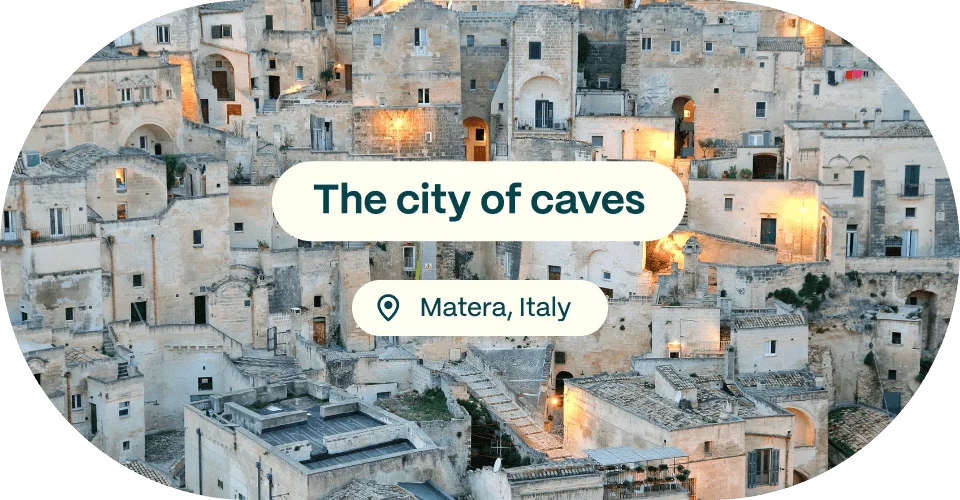
When you think of southern Italy, sparkling blue coves, beaches filled with striped umbrellas, and colorful seaside towns likely come to mind. Staying in a prehistoric cave dwelling might not be high on your list of things to do—but maybe it should be.
The ancient city of Matera, at the top of the boot’s instep, is a place truly unlike anywhere else on Earth. One of the oldest cities in the world, alongside Jericho and Aleppo, it has been the site of continuous human settlement for 10,000 years, dating back to the Paleolithic period. The city is built along the sides of a deep ravine pockmarked by natural caves, holes in the rock where early humans once dwelled. Looking out over the ravine, you can almost picture the hunter-gatherers perched in these nooks thousands of years ago.
Several civilizations have settled here throughout human history, layering ruins upon ruins. An archaeological dig in 1906 found Christian coffins from around 800 CE beneath the town center. Underneath that, Byzantine columns and statues from 400 CE were found, and beneath that, ancient Greek and Roman coins—and even further below, ceramic shards dating back 3,000 years.
What has resulted is a fascinating amalgamation of ancient and modern history: churches from the Middle Ages, prehistoric cave dwellings transformed into modern-day homes and businesses, and a maze of underground cisterns and interconnected passages that run underneath the cobblestoned surface.
|
|
|

IHG One Rewards Premier Credit Card
Earn rewards your way with the IHG One Rewards Premier Credit Card from Chase. With this limited-time offer, you can earn 5 FREE NIGHTS at IHG® Hotels & Resorts, valued at up to 300,000 total points — our highest points offer of 2025. The IHG One Rewards Premier Card lets you earn 5X points for every $1 spent on travel, dining, gas, and select streaming services, and up to 26X total points at IHG® Hotels & Resorts.
|
|
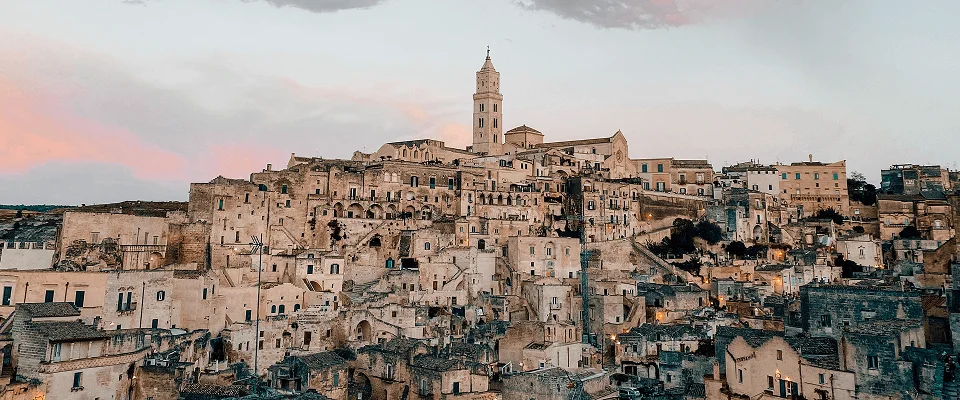
Today Matera, a beige crush of limestone buildings rising up out of the ravine, is a dazzling sight to behold. The Civita, the town center, sits high on a hill, accented by the bell tower of the Duomo and surrounded by picturesque piazzas, quaint cafes and restaurants, and zig-zagging staircases and alleyways. Spread out below on either side of the hill are the Sassi, some 1,500 cave dwellings carved into the limestone seemingly stacked on top of each other at random, with streets often winding on top of houses. It is the Sassi, these unique cave homes, that have drawn the most attention to this remarkable city.
As recently as the 1940s, entire families, sometimes of 10 people or more, lived along with their pets and livestock crammed in the caves—often no larger than a small living room—in unsanitary conditions without plumbing or electricity. It had become a forgotten peasant’s village until 1945 when Carlo Levi’s memoir Christ Stopped at Eboli detailed the abject poverty and rampant disease he encountered there. Soon, the town became known as la vergogna nazionale (a national disgrace). In 1950, the Italian Prime Minister, appalled by the living conditions, began forcibly relocating all of the town’s 15,000 residents out of the Sassi and into modern housing developments.
|
|
|
Protect your trip in 60 seconds with Faye travel insurance.
|
|
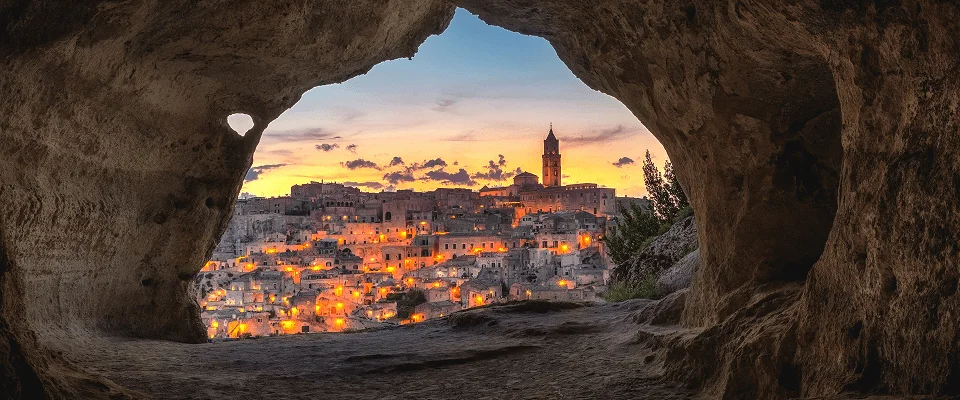
But not everyone felt Matera deserved its poverty-stricken infamy. In 1959, a group of local students and friends, all between the ages of 20 and 30, formed a cultural society called Circolo La Scaletta. Called by “the conviction that they were not children of a city immersed in poverty, but of a place rich in history,” La Scaletta led the effort in researching, documenting, protecting, and promoting the incredible history and architectural wonders of Matera.
The group’s lobbying and restoration work of the ancient cave system began changing public sentiment: By the late '60s, even Carlo Levi himself declared the Sassi to be an architectural treasure “on a par with the Grand Canal of Venice.”
In 1993, UNESCO listed the Sassi as a World Heritage site, calling it “the most outstanding, intact example of a troglodyte settlement in the Mediterranean region.”
By 2019, the once-maligned city had gone through a total rebirth: It was named a European Capital of Culture, featured in several movies (Bond and DC Comics blockbusters, as well as biblical films), and was one of the fastest-growing tourist destinations in southern Italy.
Now, about half of the city’s labyrinthine grotte have been restored into livable homes, restaurants, art exhibits, shops, and even an underground swimming pool—all of which make for a wondrous place to explore for a couple of days.
|
|
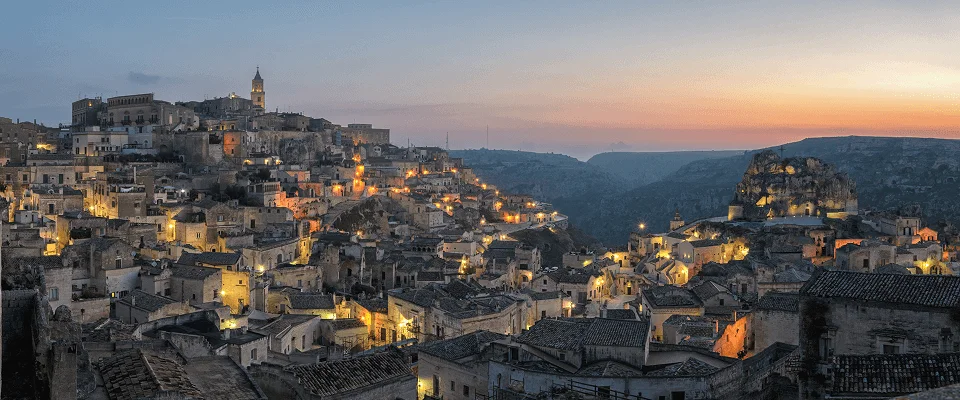
Perhaps most notably, some of the Sassi have been transformed into stunning boutique cave hotels, aiming both to honor Matera’s history and attract tourism that benefits the city. Taking great care to preserve the original caves (and the two-million-year-old fossils in the walls), they have been meticulously refurbished into rooms with all the amenities one would need to be comfortable: plush beds, bathrooms with deep soaking tubs, and simple furniture to hold your belongings. But the floors, walls, and vaulted ceilings are all made of thick slabs of cool limestone.
Aquatio Cave Luxury Hotel & Spa has more modern rooms with televisions and lighted vanities, plus a dreamy heated pool in a cavern. Sextantio Le Grotte Della Civita offers one of the more authentic—and unforgettable—cave dwelling experiences: minimalist suites, where turndown service includes lighting candles all over your room for a romantic welcome back to your cave. Breakfast is served in a 13th-century deconsecrated rupestrian (rock) church with a view out to the ravine.
Staying in a cave hotel may be one of the most unique accommodation experiences you’ll ever have. After a day of exploring this place so rich with history, it’s only fitting to experience a little of it for yourself. Watching the soft amber glow of candlelight dancing on the stone walls of your cave room, it’s hard not to ponder in quiet awe what life was like on this very site millennia ago.
|
|
How to do it
Want to venture into the caves of Matera? The best time to go, how much it costs, and other things to consider: Find it all in our online guide.
|
|
|
|
Getting there
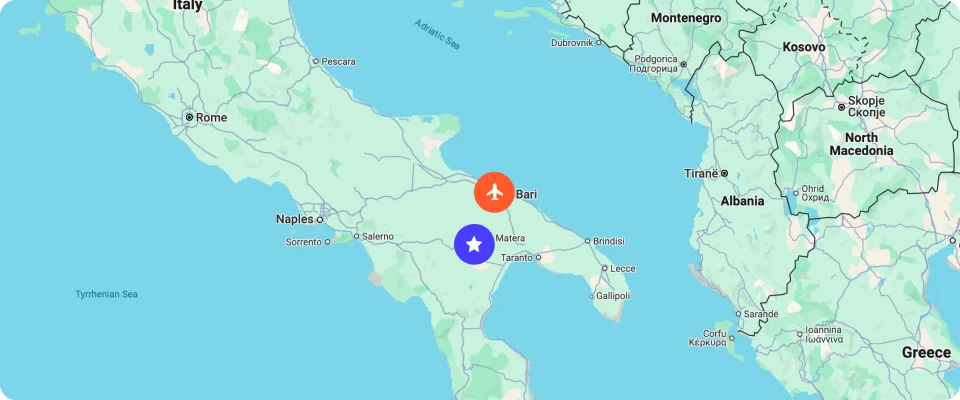
While nearby Puglia has become a popular tourist destination for its many photogenic attractions—golden beaches and rocky coves, vineyards, and whitewashed cities with traditional trulli houses—Matera is still often overlooked, despite being just a quick detour from the region’s other sights. Technically in the region of Basilicata, it is well worth the extra time—less than an hour drive from Bari (BRI), Puglia’s capital, and the nearest airport—to stop there for a night or two. If you’d prefer not to drive (though highly recommended to be able to explore this beautiful part of Italy, especially without having to backtrack), you can take a train or bus from Bari to Matera. If you’re coming from Naples, the best way to arrive is by car, which should take about three hours.
|
|
$554 Average Going deal
|
|
$1000 Normal ticket price
|
|
|
|

|
Interested in a trip to Matera?
Premium and Elite members get alerts for specific trip destinations and dates in the Going app.
|
|
|
Related content
Puglia: The bicoastal region that produces 40% of Italy’s olive oil
Read more
|
|
|

Flight alerts are now unlocked
Limited members can now track price drops for specific trips. Even better, set an alert by June 16th for a chance to win $1,000 in free flights!
|
|

|
|
With local expert:
Karen I. Chen
|
Karen I. Chen is a travel and lifestyle writer who has lived in Shanghai, Rio de Janeiro, and now New York City. Also a travel advisor, she spends much of her time researching hotels and plotting her next adventure—though more often than not, she’s dreaming of hopping the next flight back to Rio’s beaches.
|
|
|
Share with a fellow travel lover by forwarding to a friend.
|
|
|
Get the app today 
|
|
|