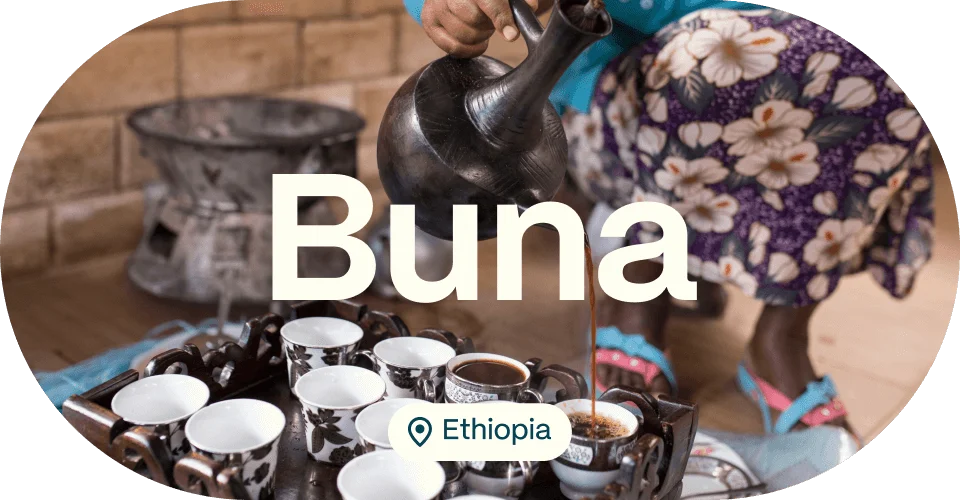
The rituals around certain foods are prevalent the world over, where the significance lies not solely in the food itself but rather in the ceremonial practices that accompany it.
Take Ethiopian coffee culture, for instance, where a traditional buna (coffee) ceremony is more than just a cup to energize you in the morning—it’s a celebration of the drink that has been woven into the country's social fabric since the 9th century.
Being invited to this ritual is regarded as a gesture of friendship and respect, showcasing the remarkable hospitality that characterizes Ethiopian culture. Luckily, Ethiopians are quick to share this culture with visitors, as residents, hotels, and restaurants regularly organize ceremonies where you can get a taste of buna.
The national drink of Ethiopia is coffee, and it is consumed everyday but never alone. “Unlike in cities like New York, London, or LA, where ‘coffee-to-go’ is almost a norm, in Ethiopia, every meeting includes coffee, and coffee always requires company,” says Nardos Street, the owner of Bereka Coffee, an Ethiopian coffee shop and mobile coffee trailer in Akron, Ohio.
Street not only sells Ethiopian coffee, she and her husband also conduct Ethiopian coffee ceremonies in the community. “It is a great way to showcase my heritage and bring forth a deeper understanding of what it means to be Ethiopian,” she says.
Ethiopia—the largest coffee producer in Africa and the fourth-largest worldwide—produces 5 percent of the world’s coffee. The industry also makes up about 5 percent of the country's gross domestic product (GDP) and employs more than 15 million farmers. The country consumes a staggering 40 percent of its crop, a stark contrast to other coffee-growing countries, such as Colombia, which consumes about 18 percent.
|
|
|

Limited-time offer: Popular airline card
Earn 70K bonus miles and a discounted ticket for a plus-one after qualifying spending.
If you want to travel more in 2025, this card offer is a great chance to get hard-to-earn miles with one of the most popular US airline loyalty programs.
|
|

The birth of Ethiopian buna
Coffee beans were discovered in Ethiopia’s southwestern province of Kaffa in the 9th century by goat herder Kaldi’s stock as they grazed on the fruit of a coffee plant. Legend has it that the goats were so energized that they couldn’t sleep at night, so Kaldi rushed the mysterious fruit to nearby monks, who promptly tossed it into the fire to destroy the potentially sinful fruit.
However, the roasted fruit exhibited two redeeming qualities: a delectable aroma and, when crushed and steeped in hot water, a drink with an invigorating kick. Coffee.
The brew gave a buzz to the monks' daily devotions, allowing them to continue their prayer long into the night. Slowly, as people migrated from region to region, country to country, the popularity of coffee spread throughout Ethiopia and eventually the world.
“Buna tetu,” which translates to “come drink coffee,” is a famous communal tradition in Ethiopia. Recollecting her own buna experiences growing up, Street says, “Every evening, we would have buna, and my parents would send me to our neighbors’ homes, inviting them to come share coffee. It was our way of socializing after a long, hard day of work and school.”
|
|
|

Need a last minute gift?
Get 25% off gift cards for 1, 2, and 5 years of Premium or Elite memberships.
|
|
Buna rituals
The coffee-brewing tradition in Ethiopia has several special elements. It’s usually done by women, either the wife or eldest girl of the house, and they’re dressed in traditional Ethiopian clothes called habesha kemis.
Even before the ceremony, the dining room is cleaned and purified. The coffee cups are arranged on a table along with snacks, such as popcorn. Freshly cut grass is placed on both the floor and the table, and sweet incense is burned as a way to carry away evil spirits.
Preparing a cup of buna can take more than an hour. Drinking takes even longer, especially during festivities and celebrations. The ceremony involves various steps to process the raw, unwashed coffee beans into finished cups of brewed coffee.
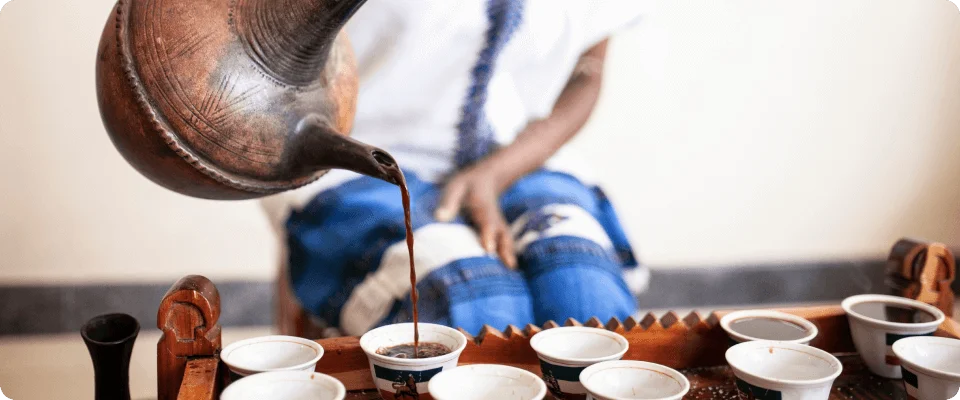
It begins with washing and roasting the beans on an iron pan called a mitad. Once the coffee beans are roasted, the mitad is taken to the guests so they can smell the beans. They are then coarsely ground in a traditional mortar before putting them into a jebena (a traditional Ethiopian coffee pot made of clay) in which the water has already been set to boil.
Jebenas come in various shapes and sizes and are valuable in every Ethiopian household. Depending on the region where they are made and used, they have one or two pouring spouts.
The hostess knows that the coffee is ready once aromatic foam rises to the neck of the jebena. The jebena is removed from the heat, and the particles are allowed to settle before the cups, gathered on a rekebot (coffee platter), are poured with coffee. “Even pouring the brew is an art, one that I learned from my mother,” says Street. “You have to make sure the grinds stay in the bottom and don’t flow into the cup.”
With each cup that is poured, the strength of the coffee weakens. The first cup, known as abol, is the strongest and purest. Tona, the second cup, is weaker and can be sweetened with sugar. Bereka, the last cup of coffee, is lightest, almost like decaf.
Coffee is typically served with seasonings like sugar, salt, butter, lemon, or rue leaves depending on the region. The jebena is refilled until the settled coffee bits squeeze out their very last taste and guests are finally satisfied.
It is considered impolite to leave the ceremony without consuming at least three cups—Ethiopians believe that your spirit transforms when you complete all three rounds. After the three cups, you are free to take as many more as you’d like; lingering and socializing is encouraged (and expected), especially in a home setting.
A typical buna ceremony can last anywhere from an hour to several hours, especially on weekends and public holidays. At home, it is generally a casual affair, but when a buna is performed at important celebratory events and festivals, guests are encouraged to dress their best. Gifts are not expected, unless the buna is associated with a special occasion, like an engagement or birthday celebration.
It is clear that coffee in Ethiopia is a cultural ritual and serves as a wonderful opportunity to pause, unwind, and connect with friends and neighbors. It goes beyond the simple act of drinking coffee and embodies a deeper tradition of fostering meaningful relationships and shared experiences.
|
|
Where to drink buna
Want to experience a buna ceremony? Read our guide for where to get a taste, whether in Ethiopia or a bit closer to home.
|
|

|
|
With expert:
Karthika Gupta
|
Karthika Gupta is a lifestyle and travel photographer, freelance writer, and podcaster. She writes about culture, travel, lifestyle, and food across several different print and online publications. Follow her adventures on her site CulturallyOurs or on Instagram at @karthikagupta.
|
|
|
Share with a fellow travel lover by forwarding to a friend.
|
|
|
Get the app today 
|
|


©Scott’s Cheap Flights, Inc. DBA Going
4845 Pearl East Circle, Suite 118
PMB 28648
Boulder, CO 80301-6112
Upgrade Membership
|
Advertise
|
Email Preferences
|
Unsubscribe
The editorial content here is not provided by any of the companies mentioned, and has not been reviewed, approved, or otherwise endorsed by any of these entities. Opinions expressed here are the author's alone.
This email may contain links through which we are compensated when you click on or are approved for offers.
QuinStreet, 950 Tower Lane, 6th Floor, Foster City, CA 94404
Promotional offer cannot be combined with other discounts or applied to previous subscriptions. Offer can only be redeemed on Going.com (not available in the mobile app).
|
|
|