Election Day is finally here. We thought you would appreciate this guide to the day ahead from the Today, Explained team. You can get the newsletter delivered straight to your inbox every day by signing up here. |
|
|
|
Li Zhou is a politics and policy reporter at Vox where she covers Congress and elections. Previously, she was a tech policy reporter at Politico and an editorial fellow at the Atlantic. |
|
|
|
Li Zhou is a politics and policy reporter at Vox where she covers Congress and elections. Previously, she was a tech policy reporter at Politico and an editorial fellow at the Atlantic. |
|
|
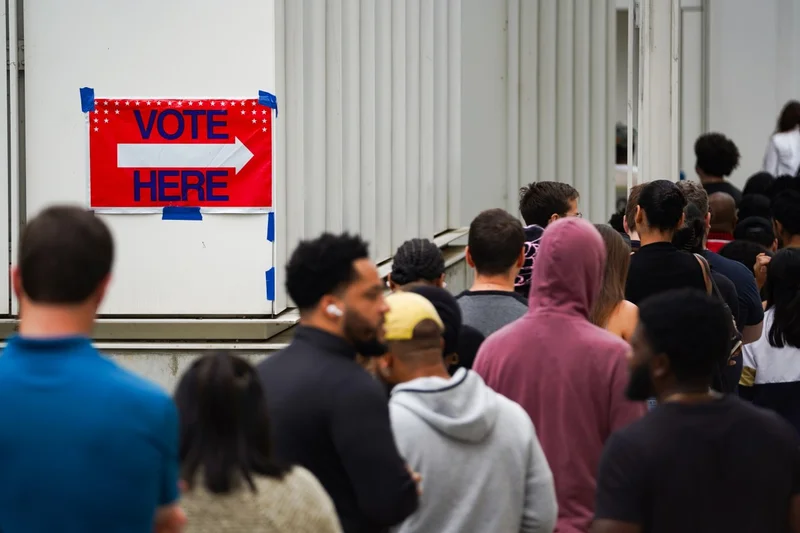
Voters wait in line at a polling location to cast their ballots on the last day of early voting for the 2024 election on November 1, 2024, in Atlanta, Georgia. Megan Varner/Getty Images. |
|
|
After months of cold sweats, nail-biting, and conjecture, Election Day is finally here.
Millions of voters across the country will head to polling places and determine everything from who will hold the presidency to control of Congress to the outcomes of local ballot initiatives. They’ll join more than 75 million people who have already voted early either in person or by mail as they weigh the presidential candidacies of Vice President Kamala Harris and former President Donald Trump, along with other third-party options.
Ultimately, the presidential race will be decided by seven key swing states where the margins between Democrats and Republicans are exceedingly close. The states — Pennsylvania, Michigan, Wisconsin, Arizona, Georgia, North Carolina, and Nevada — include some that voted for President Joe Biden in 2020, but that also voted for Trump in 2016. And as recently as this past weekend, polls were so tight in many of them that they remain a toss-up going into Election Day.
Here’s everything you need to know about these pivotal states as well as when to expect results and race decisions to start coming in. |
What time do polls close? |
Poll closures differ by state, and in certain places, even by county, so be sure to check where you live for specifics. You can do so using this tool from Democracy Works, a nonpartisan nonprofit focused on voting participation.
Broadly, though, cutoffs start at 6 pm ET in states such as Indiana and Kentucky, with many others, including Missouri, Illinois, and Tennessee, closing at 8 pm ET. Alaska and Hawaii finish out the night, wrapping up voting at midnight and 1 am ET.
In swing states, poll closures are also staggered: Georgia, North Carolina, and Pennsylvania close at 7 pm, 7:30 pm, and 8 pm ET respectively. Some Michigan counties will close at 8 pm, while others will close at 9 pm ET. Wisconsin and Arizona both close at 9 pm ET, and Nevada is the last of the seven, closing at 10 pm ET. |
When will results start coming in? |
States and counties usually start disclosing results once the polls are shuttered in their jurisdictions. Many will post vote counts online as they are being processed, and news outlets and television networks may update their trackers based on these figures.
These results are likely to change over time, however. In some places, smaller and more rural counties may be able to count their ballots more quickly than larger cities, for example. This can create the impression that one candidate is ahead. This happened in 2020, when certain vote counts suggested that Trump was initially ahead in battleground states, creating a “red mirage.”
Since it takes some states longer to count mail-in votes, that dynamic can also contribute to Republicans banking an early lead since they’re less likely to use absentee ballots.
In both instances, early leads might not match the final result, with margins potentially changing significantly as more votes are tallied. In 2020, this happened in states like Pennsylvania: As more mail-in ballots were counted, along with votes from larger cities, Biden picked up support, fueling what political observers referred to as a “blue shift.”
It’s not clear if that same dynamic will play out this cycle, but it is a helpful reminder that things could shift dramatically over the course of hours and days. |
How many electoral votes does Trump or Harris need to win, again? |
There are 538 Electoral College votes up for grabs, and a candidate needs to secure a majority — or 270 electoral votes — to win the presidency.
The majority of these votes are concentrated in safe red or blue states, meaning Trump and Harris are both guaranteed a sizable degree of support. The backing of some swing states, however, will be necessary for each to reach the 270-vote threshold, making them incredibly important. |
So, what do I need to know about these battleground states? |
The presidential race in these seven states is so close that they have the potential to flip for either Harris or Trump and deliver a sizable number of electoral votes along with it. That’s why both campaigns have been focusing their ground game and advertising here in recent weeks. |
-
Why it’s a battleground: Arizona, with 11 electoral votes, was a longstanding Republican stronghold until Democrats flipped it during a Senate race in 2018 and subsequent presidential race in 2020. Republicans still have plenty of support, so much so that it’s been a wellspring of election denialism since 2020.
-
When to expect results: A high proportion of mail-in ballots have historically been submitted on Election Day itself, and those aren’t counted until polls close, meaning there could be delays in reporting the final outcome, particularly in close races. In 2020, the Associated Press called the race on the day after the election, while other organizations, such as the New York Times, didn’t call the race until nine days after Election Day. In 2024, it could once again be several days until an official call is made.
|
-
Why it’s a battleground: Pennsylvania, with its 19 electoral votes, went to Trump in 2016 and Biden in 2020. Given its sizable number of electoral votes, the state is a major target for both parties, and could well determine who wins the election overall. Because of how competitive the race is, the state has also been a focal point for GOP misinformation about voter fraud, which remains very rare.
- When to expect results: Pennsylvania isn’t allowed to process or count mail-in ballots until Election Day. In 2020, the AP reported Biden as the winner four days after Election Day. The timing could be similar this election, depending on how many voters opt for mail-in ballots.
|
-
Why it’s a battleground: Trump won the state’s 10 electoral votes in 2016, and Biden retook them in 2020. It has a Democratic governor, one Democratic senator, one Republican senator, and two Republican-led chambers in the legislature.
-
When to expect results: In 2020, Wisconsin was called by the AP the day after the election and that could happen again, but it’s worth noting that mail-in ballots aren’t counted until Election Day.
|
-
Why it’s a battleground: Georgia, which has an enduring Republican lean, only recently flipped to Democrats during the 2020 presidential election and then narrowly reelected a Democrat to the Senate in 2022. Previously, Georgia, with its 16 electoral votes, was a major target of Trump’s attacks in 2020, when he called on officials in the state to overturn its results.
- When to expect results: In 2020, an extremely tight margin resulted in election results being called by the AP a full 16 days after the race. The turnaround could potentially be faster this year depending on the margin in the race.
|
- Why it’s a battleground: Nevada, which has 6 electoral votes, has voted Democratic pretty consistently, but has moved right in recent elections, however, and elected a Republican governor in 2022. This cycle, the economy is a key issue that may fuel discontent toward Democrats.
-
When to expect results: Nevada has expansive mail-in voting. In 2020, election results were called by the AP four days after the election, and it’s possible that could happen again.
|
How will I know the race is actually called? |
Vox will monitor a variety of sources before we publish election results, including the Associated Press and the National Election Pool, a poll conducted by Edison Research and funded by several major news organizations.
States and counties are in charge of running elections, reporting results and certifying those outcomes. There’s a gap, however, between when states report the results of the election and when they declare a winner because of the certification process.
The AP is one of the entities that fills in the gap in the meantime by analyzing the unofficial results that states and counties are posting. Vox’s Ellen Ioanes has a more detailed explainer on how publications like the Associated Press make these calls. |
How long is all this going to take? |
It’s likely that this entire process could take several days, as it did in 2020. That year, in particular, it took more time to determine the winner of the election because more people used mail-in ballots due to the pandemic.
The last presidential election also saw some of the highest voter turnout in years, and extremely close margins in key swing states. Both those dynamics meant that ballot-counting and determining whether a candidate had secured a high enough lead to win simply took longer.
In 2020, it took four days before President Joe Biden was declared the winner of the Electoral College by publications including the Associated Press. That year, states like Georgia also saw legal challenges to their outcomes from the Trump campaign, which falsely alleged widespread fraud. States could see similar lawsuits this cycle, and those could fuel uncertainty about the legitimacy of the result, though they haven’t previously delayed calls by entities like the AP.
This year, don’t be alarmed if results aren’t announced immediately once again and it takes a few days to arrive at an outcome. |
|
|
https://link.vox.com/oc/66d76bffcf7e8ce8f309a846m8b0q.8lai/179caa96
|
|
|
|